USA Banner

Official US Government Icon

Official websites use .gov
A .gov website belongs to an official government organization in the United States.

Secure Site Icon

Secure .gov websites use HTTPS
A lock ( ) or https:// means you’ve safely connected to the .gov website. Share sensitive information only on official, secure websites.

U.S. Department of Transportation U.S. Department of Transportation Icon United States Department of Transportation United States Department of Transportation

Noteworthy Practices

Left Nav - HSA Learn Safety

SHSP Road Shows

Original publication: HSIP Noteworthy Practice Series, SHSP Stakeholder Involvement; FHWA-SA-11-02; 2011(PDF, 2.6MB)


The Nevada Departments of Transportation and Public Safety published the State’s first Strategic Highway Safety Plan (SHSP) in September 2006. In April 2010, the Departments conducted a series of road show meetings across the state in an effort to further engage safety stakeholders and educate them about the SHSP, provide an opportunity for input into the SHSP update, and market the October 2010 SHSP Summit.

Nevada has created a master SHSP e-mail list that includes engineers, law enforcement officers, transportation planners, education specialists, health care providers, injury prevention practitioners, emergency responders, citizen activists, and anyone else concerned about traffic safety. In April 2010, more than 100 people attended the meetings held in four locations. The format for each of the Road Show meetings involved presentations from the two state leaders of the SHSP and a facilitated discussion with participants.

During the meetings, Road Show participants learned about Nevada’s new zero fatality goal. They were also given an opportunity to describe existing programs that address the critical emphasis areas of the SHSP. This exercise in enumerating programs was also used as an opportunity to promote the Nevada Big Book of Safety and identify programs not documented in this clearinghouse for Nevada’s traffic safety-related projects and programs. The Big Book of Safety is on-line and intended to be a quick-access, searchable list for agencies and the public to use as-needed for research, contact information, and details on Nevada’s traffic safety initiatives. The Big Book is a living document and will be updated as feedback is received from participating agencies and stakeholders about program details, additions, removals, or corrections.

Road Show participants provided ideas and suggestions for safety programs and activities that could be included in the SHSP update. Finally, participants heard about funding and other resource opportunities.
"Strategic Highway Safety Plan's Drive Safe Nevada logo"

Key Accomplishments

  • Engaged over 100 stakeholders representing 4Es of safety and different levels of government.
  • Held 4 road show meetings to collect stakeholder input to inform SHSP update process.
  • Renewed enthusiasm for the statewide safety efforts.

Results

Presenters and attendees agreed the meetings were a success and accomplished the objectives – stakeholders learned about the SHSP process, their interest was piqued, and it created opportunities for potential synergies among the various safety groups. It was also a good way to get people energized and interested in the upcoming Traffic Safety Summit. Not one of the meetings ended early and most people wanted to continue to talk. The press attended two meetings, including a local Las Vegas television station.

Contact

Chuck Reider
Chief Safety Engineer
Nevada DOT
775-888-7335
creider@dot.state.nv.us
Louisiana Hires Law Enforcement Expert to Improve Data Collection among Law Enforcement Agencies

Original publication: HSIP Noteworthy Practice Series, Safety Data Collection, Analysis, and Sharing; FHWA-SA-11-02; 2011(PDF, 1.6MB)


The Louisiana Department of Transportation and Development (LDOTD) is responsible for collecting motor vehicle crash data for the entire State of Louisiana, as well as maintaining the state crash database. This equates to about 165,000 crash reports a year from state, parish, and local law enforcement agencies. The accuracy and timeliness of this data are critical in prioritizing safety improvements for roadways and intersections. LDOTD has the responsibility to ensure prioritization of limited highway safety funds is based on the ability to reduce the most crashes, injuries, and fatalities relative to the initial construction cost and any associated increase in maintenance costs. LDOTD analyzes the entire state roadway system on a yearly basis and compiles a list of locations exceeding a threshold for crashes, injuries, and fatalities to allocate highway safety funds where the greatest safety benefit can be achieved.

LDOTD found incorrect and incomplete coding of the crash reports by law enforcement officers affected the quality and accuracy of the crash data. In addition, the Legislature designated LDOTD as the agency responsible for implementing and coordinating a Statewide Incident Management Program, which requires widespread statewide coordination between LDOTD, law enforcement agencies, and emergency response personnel. In 2008, the agency hired a Law Enforcement Expert (LEE) to help address data deficiencies and meet the new Legislative requirement. Given the responsibilities of the position and because the LEE would reach out to a wide variety of law enforcement officers, a decision was made to hire a person with significant leadership experience with the state police, i.e., a Captain or above.

The LEE works statewide and reviews crash reports to identify trends or potential issues with crash report completion by the various jurisdictions. For example, the LEE might identify a disproportionately high number of crashes with the contributing factor marked as “failure to control” within a particular agency. When this type of situation arises, the LEE meets with the agency to identify any underlying reasons for the trend in reporting (e.g., training, edit checks, etc.). If there are issues, the LEE helps train the officers on proper procedures. Additional LEE responsibilities directly related to improving the quality and accuracy of crash data include:

  • Develop a student and train-the-trainer course in crash investigation to familiarize law enforcement personnel with the concepts and techniques of crash reconstruction.
  • Schedule classes and train law enforcement academy instructors in crash investigation and reconstruction concepts and techniques (train-the-trainer course).
  • Schedule classes and train students in crash investigation and in reconstruction concepts and techniques.
  • Provide crash investigation and reconstruction services to the Highway Safety Section for the LDOTD Tort Reduction Program.
  • Provide crash investigation and reconstruction expertise to the nine LDOTD Districts during their investigation of crash locations.
  • Serve as a member on the statewide Traffic Records Coordinating Committee (TRCC) and the Sub-committee responsible for revising the State crash report to adhere to required Model Uniform Crash Criteria (MUCC).

The LEE also assists with Strategic Highway Safety Plan (SHSP) implementation at both the local and regional level. Working with LDOTD and Louisiana State University, the LEE provides the SHSP regional coalitions with the data they need to develop and implement regional action plans, strategies, and performance measures.

Key Accomplishments

  • LDOTD is among the first DOTs to hire a Law Enforcement Expert (LEE) dedicated to working with law enforcement agencies on improving crash data collection.
  • Instituted a direct link between LDOTD (both headquarters and District offices) and law enforcement agencies around the State.
  • Utilizing a former law enforcement officer has facilitated communication and outreach to local law enforcement agencies.

Results

Louisiana’s crash data accuracy and completeness have been enhanced through the use of the LEE, which has led to better informed decision-making in the State’s efforts to improve safety. Training law enforcement agencies has greatly improved location data through better application of Global Positioning System (GPS) technology. Educating local law enforcement officers on the electronic crash report form and increasing their awareness and understanding of the importance of accurate, complete data has resulted in more regular reporting of data elements previously often omitted, such as the manner of collision. Outreach to local law enforcement has also raised awareness of the availability of data from the state to guide local crash reduction programs.

Contact

Terri Monaghan
Highway Safety Manager
Louisiana Department of Transportation and Development
225-379-1941
Terri.Monaghan@la.gov

Focusing on Fewer Emphasis Areas

Original publication: HSIP Noteworthy Practice Series, Revisiting SHSP Emphasis Areas; FHWA-SA-11-02; 2011(PDF, 1.9MB)


In September 2007, West Virginia released its first statewide Strategic Highway Safety Plan (SHSP). The 2007 SHSP included nine emphasis areas established by the Highway Safety Management Team (HSMT) (The HSMT is a group of representatives from many facets of state and Federal agencies which all have some area of highways safety responsibilities within their purview. Since the early to mid 1990s this group has existed either formally or informally and has strived to coordinate and effectively manage highway safety programs and initiatives in West Virginia.) based on analysis of six years of fatality, serious injury, and crash data, along with stakeholder input. Some emphasis areas included subareas. For example, at risk drivers and users included: suspended or revoked drivers, unlicensed drivers, multiple crash/citation drivers, uninsured drivers, younger drivers, older drivers, motorcycles, and ATV drivers. Including all subareas, the State was attempting to address 23 different areas within the purview of the SHSP.

After several years of attempting implementation, it became clear to the HSMT that the scope of the SHSP was unmanageable. Staff from the different agencies were stretched too thin. Having to participate in all the different areas but being unable to dedicate sufficient attention to individual areas stalled implementation and discouraged personnel. In attempting to address the priorities of every stakeholder who had come to the table, they had taken on too much.

Recognizing it was time to update their SHSP, the HSMT knew they wanted to take a different approach but did not have a clear plan of action until getting involved as one of the pilot states for the National SHSP Implementation Process Model (IPM). The pilot provided the opportunity to breathe new life into West Virginia’s SHSP. It offered new ideas through implementation strategies from the IPM as well as through regular discussions about experiences and lessons learned with other pilot states. Among other takeaways, involvement in the pilot convinced the HSMT that making their plan work would require reducing the number of emphasis areas.

The process began by focusing on the original goal of “Zero Fatalities…Saving One Life at a Time.” The goal had been buried on page five of the original SHSP but was brought front and center in the update and subsequent marketing campaigns.

The HSMT took a new look at the data to determine which emphasis areas had the greatest potential for meeting the goal. They reevaluated the data seeking a noticeable break in the number of fatalities attributed to different contributing factors and were able to identify four emphasis areas accounting for the majority of fatalities on West Virginia roadways: roadway departure, occupant protection, impaired drivers, and at-risk driver age groups (ages 15 to 20 and over 65). They further reinforced the selection by cross analyzing the data and finding these four areas encompassed large portions of other crash types (i.e., roadway departures crashes involved many of the heavy truck, wildlife, and speeding-related crashes). Stakeholders focusing on the other individual crash types were thus invited to participate in emphasis area teams to explore ways to collectively address common concerns. Finally, a fifth emphasis area, improving highway safety data, was added to the update acknowledging the importance of a data-driven approach to safety.

"Zero Fatalities: Saving One Life at a Time logo"

Key Accomplishments

  • Narrowed SHSP emphasis areas down to a more manageable number through a data-driven process.
  • Provided a more focused scope for pursuing the goal of “Zero Fatalities…Saving One Life at a Time.”
  • Re-energized partners leading to more active involvement in SHSP efforts.

Results

The updated SHSP is due for publication in the fall of 2010, but the process of paring down the number of emphasis areas has already reinvigorated stakeholders and generated strong support from safety partners. The HSMT is strong and active. With fewer emphasis areas, partners have been able to commit time to participate in meetings and collaborative efforts. Communications staff are now assigned to every team and are more prepared to answer questions from the public. Marketing efforts, both internally and externally, have been made easier with a more focused SHSP.

Contact

Donna Hardy
Regional Traffic Safety Engineer
West Virginia Department of Transportation
(302) 659-4060
Donna.J.Hardy@wv.gov

SHSP Operations Manager

Original publication: SHSP Implementation Process Model, Supplement Number 1 – Case Studies; FHWA-SA-10-025; 2010(PDF, 1MB)


Key Accomplishments

  • Created the position of full-time SHSP operations manager to provide leadership and coordination.
  • Centralized SHSP communications through the operations manager.
  • Formalized safety collaboration between the DOT and GOHS via a memorandum of understanding.

Prior to the development of the SHSP, the Georgia Department of Transportation (GDOT) created a Safety Action Plan. The plan was based on the NCHRP 501 Integrated Safety Management Process (ISMP). Fundamental to the ISMP is an interdisciplinary organizational structure formed through a coalition of highway safety agencies that allocates different responsibilities to specific groups or people who must work together to maximize safety. Day-to-day management responsibility falls to the operations manager, a coalition appointee.

After SAFETEA-LU required States to develop an SHSP, GDOT merged its Safety Action Plan into the SHSP and developed its structure based on the ISMP. GDOT stepped aside from the leadership role to encourage an interdisciplinary and intery structure so partners and stakeholders would not view their participation as directed by GDOT. They felt stakeholders would be more likely to participate and provide legitimate feedback if the Governor’s Office of Highway Safety (GOHS) took responsibility for leading the SHSP effort.

GDOT and GOHS developed a memorandum of understanding creating a SHSP Operations Manager position housed in the GOHS. The Operations Manager acts as the focal point for the SHSP. As part of GOHS, the Operations Manager dedicates time and effort to facilitating the development and implementation of the SHSP, as well as coordinating communication among GOHS, GDOT, and the other partners and stakeholders. The Operations Manager is funded by GDOT with Highway Safety Improvement Program funds.

Results

The State demonstrated its commitment to the SHSP by creating a full-time staff position to oversee its management and implementation. The Operations Manager handles the day-to-day administration of the SHSP process and provides support to the SHSP Leadership Team. As the focal point of the SHSP process, the Operations Manager facilitates all activities.

Contact:
Randy Clayton
SHSP Operations Manager
Georgia Governor’s Office of Highway Safety
404-651-8503
rclayton@gohs.ga.gov

Engaging Local Agencies in Commercial Vehicle Inspection

Original publication: SHSP Implementation Process Model, Supplement Number 1 – Case Studies; FHWA-SA-10-025; 2010(PDF, 1MB)


Key Accomplishments

  • Increased commercial vehicle inspections.
  • Improved local law enforcement knowledge of Federal safety regulations and commercial vehicle safety issues.
  • Increased local officer confidence in conducting truck inspections.

Commercial vehicle safety is an emphasis area in the Michigan SHSP, with goals including reduced fatigue-related crashes, improved heavy truck maintenance, and a strengthened commercial driver license program. The commercial vehicle safety emphasis area action plan identifies enforcement as a strategy for achieving SHSP goals; however State resources are limited. To extend enforcement capabilities, the State Police developed programs to engage local law enforcement in commercial vehicle inspections.

Michigan State Police conduct basic commercial vehicle inspection introductory classes and train local police agencies to conduct North American commercial vehicle inspections. Through a Special Transportation Enforcement Team (STET), State Police provide field training and mentoring for local officers certified to conduct inspections. The STET officers work alongside local police during special training sessions. During a typical event, State Police set up temporary operations at a weigh station, rest area, or along the roadside and offer field training to local officers certified in North American inspections. This format enables experienced State commercial vehicle enforcement specialists to communicate enforcement strategies and best practices to local law enforcement.

Results

Thirty local agencies have been certified to conduct North American standard inspections and hours of service enforcement, and some local agencies have established dedicated commercial vehicle enforcement teams.

Contact:
Lt. Ron Crampton
Traffic Safety Division
Michigan State Police
517-336-6476
CramptonR@michigan.gov

Training Improves Local Safety Planning Capacity

Original publication: SHSP Implementation Process Model, Supplement Number 1 – Case Studies; FHWA-SA-10-025; 2010(PDF, 1MB)


Key Accomplishments

  • Improved the ability of local governments to conduct safety studies according to State guidelines.
  • Enhanced the safety culture in local agencies.
  • Improved consistency of safety studies among local governments and MPOs.

To reduce fatalities and injuries throughout New Jersey, agencies and organizations at the local level need to participate in safety planning. However, many local governments and metropolitan planning organizations (MPO) have limited staff and resources available to conduct safety studies; therefore, the New Jersey Department of Transportation (NJDOT) recognized a need to increase safety capacity at the local level.

On a regular basis, NJDOT provides MPOs and local governments a list of locations with a high-crash frequency. Local jurisdictions are required to conduct studies to identify contributing crash factors and develop strategies to improve safety at these locations. NJDOT developed a Safety Study Guidelines Course to train local governments, MPOs, and consultants retained by local governments to determine crash contributing factors and to identify strategies for improving high-crash locations.

The course trains people how to apply a systematic process to conduct safety studies. The process involves five components:

  • Confirm and clarify problems, goals, and project needs;
  • Collect data;
  • Analyze data and select relevant studies (i.e., volume, signal warrant, capacity analysis, sight distance);
  • Identify and evaluate countermeasures; and
  • Recommend a plan.

The course also familiarizes students with the project development process, project selection criteria, and key individuals typically involved in the process.

NJDOT strongly encourages local governments to participate in the Safety Study Guidelines Course. Consultants performing safety studies for local governments or MPOs are required to complete the Safety Study Guidelines Course before working on projects utilizing Federal funding.

Results

The course has improved the SHSP by providing a consistent format and guidelines for safety studies. Instead of simply providing technical analysis support to local agencies, the training enhances the safety knowledge and culture of local governments and MPOs. City, county, and regional planners and engineers now have increased capacity to perform safety studies, including roadway safety audits, and are educated about the SHSP process.

Contact:
Patricia Ott
Director, Traffic Engineering and Safety
New Jersey DOT
609-530-2488
Patricia.Ott@dot.state.nj.us

Branding and Marketing the SHSP

Original publication: SHSP Implementation Process Model, Supplement Number 1 – Case Studies; FHWA-SA-10-025; 2010(PDF, 1MB)


Key Accomplishments

  • Fostered increased public awareness and support through SHSP branding.
  • Promoted SHSP successes via a marketing plan.

SHSPs provide a State’s safety stakeholders with clear and consistent goals, performance measures, and strategies for addressing motor vehicle-related fatalities and injuries. States are using branding and marketing to increase exposure and gain support of their plans among their partners and the public.

States with a strong core goal have been successful in using it as the message to promote their SHSP. Such messages include “Zero Fatalities: A Goals We Can Live With,” “Toward Zero Deaths,” and “Target Zero.” Developing goals like this requires strong support from everyone in the participating agencies’ management structures. Other States have chosen effective yet softer messages such as, “Blueprint to Arrive Alive” or “Blueprint to Safer Roadways” to promote their SHSPs.

Branding focuses the public on the SHSP and its related programs, and not on an agency. This is effective in promoting the safety coalition’s partnership, eliminating any agency’s “baggage” (intraagency or with the public), and mitigating turf issues among coalition members. One State reflected on the advantage of a branded message as, “It doesn’t belong to anybody; it belongs to everybody.”

Branding the SHSP ensures all partners send a consistent message. Logos, messaging, and collateral artwork are often created and distributed to coalition members and provided to safety partners, ensuring unity of appearance Statewide. At least one State (Utah) is implementing an integrated and comprehensive media/marketing plan to further promote their SHSP and zero goal. Media campaigns, billboards, and events heighten awareness and support for SHSP programs through a unified marketing plan. The unified plan is a year-long coordination effort to maximize the media resources available for outreach and allows for a near weekly safety campaign message through varying media outlets. Federal funds are used to support the cost of the marketing plan, and some costs are absorbed by individual agencies through their normal marketing efforts.

Results

Effective branding combined with a comprehensive media/marketing plan has resulted in increased stakeholder and public recognition and support of the State’s SHSP and its implementation strategies.

Contact:
Robert Hull
Director, Traffic and Safety Division
Utah DOT
801-965-4273
rhull@utah.gov

Implementation of Systemwide Improvements

Original publication: HSIP Noteworthy Practice Series, HSIP Project Identification; FHWA-SA-11-02; 2011(PDF, 2.7MB)


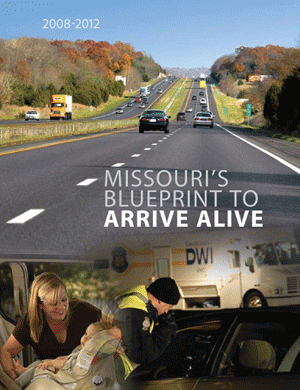
The Missouri Department of Transportation (MoDOT) has been successfully shifting the focus of its Highway Safety Improvement Program (HSIP) towards a more proactive approach through the implementation of systemwide improvements. Many of these efforts began through the implementation of the Smooth Roads Initiative in 2004. The original initiative included 2,200 miles of resurfacing, installation of reflective pavement markings and signage, improved shoulders with rumble strips/stripes, and safer guardrails. Given the safety benefits realized through these improvements, the state incorporated many of them into Missouri’s Blueprint to Arrive Alive (the state’s strategic highway safety plan).

Missouri’s Blueprint is used to guide HSIP investments. The Blueprint identifies the state’s “Targeted 10” strategies in education, enforcement, engineering, and public policy areas. These strategies were selected based on documented evidence supporting their life-saving and injury reduction potential. Six of the strategies are engineering countermeasures being implemented on a systemwide basis, including:

  • Expand the installation of shoulder and centerline rumble strips/stripes;
  • Expand, improve, and maintain roadway visibility features (pavement markings, signs, lighting, etc);
  • Expand installation and maintenance of roadway shoulders;
  • Remove and/or shield fixed objects along roadside right of way;
  • Improve and expand intersection safety with the use of innovative engineering designs (e.g., J-turns, roundabouts); and
  • Improve curve recognition through the use of signs, markings, and pavement treatments.

The state uses HSIP funding for many of these strategies proactively incorporating the installation of rumble strips/stripes, improved signing and delineation, wider pavement markings, and improved shoulders into pavement resurfacing projects.

Currently the state focuses its funding on the state roadway system since, historically, 77 percent of the fatalities in Missouri occur on state roads. In order to achieve the greatest benefit for the funds invested, Missouri originally focused on incorporating the safety enhancements into resurfacing projects on major roadways (about 5,600 centerline miles) experiencing a disproportionate 45 percent of all fatal crashes. Following positive results from those original efforts, MoDOT is currently considering incorporating two-foot shoulders into future resurfacing projects on less traveled roadways (e.g., minor arterials, major collectors). Missouri also has become a national leader in the installation of cable median barrier to reduce cross-median fatalities on the majority of the interstate system throughout the state.

"Cover of Missouri's Blueprint to Arrive Alive 2008-2012 document"

Key Accomplishments

  • Allocated almost two-thirds of HSIP funds to systemwide improvements.
  • Created a safer roadway system overall.

Results

Since 2007, almost two-thirds of Missouri’s HSIP funds have been allocated to systemwide improvements. By focusing more on systemwide improvements, the state has been able to create a safer system overall. Between 2005 and 2010, Missouri has seen a 30 percent drop in overall fatalities and a 41 percent reduction in lane departure fatalities. In addition, the installation of cable median barriers on the interstate system throughout the state resulted in an 80 percent reduction in cross median crash fatalities on Missouri freeways.

Contact

John Miller
Traffic Safety Engineer
Missouri Department of Transportation
573-526-1759
John.p.miller@modot.mo.gov

Law Enforcement Partnership with Engineering

Original publication: SHSP Implementation Process Model, Supplement Number 1 – Case Studies; FHWA-SA-10-025; 2010(PDF, 1MB)


Key Accomplishments

  • Improved understanding among law enforcement and engineering of how safety roles complement each other.
  • Improved safety accountability among law enforcement.
  • Trained county crash reconstruction officers and State safety education officers on RSAs.

The Illinois DOT’s (IDOT) Bureau of Safety Engineering developed a strong partnership with law enforcement resulting in improved safety outcomes. In 2005, when the Bureau of Safety Engineering was created, it took on the responsibility of photo enforcement formerly handled by IDOT operations. By assuming this responsibility, the Bureau began working directly with the Illinois State Police who managed this effort in work zones. At the same time, the State was developing its first SHSP and recognizing the importance of collaboration among the 4Es of safety. During a meeting involving law enforcement and engineers, police noted that when it rained on I-55 north of Springfield, cars were going off the road. The Bureau engineers investigated and identified a pavement friction issue, which they fixed. This experience served as a catalyst to ramping up collaboration between law enforcement and engineers, and IDOT started to integrate enforcement at district meetings as a regular part of doing business.

IDOT began working closely with local law enforcement, particularly in high fatal crash counties. When IDOT identified a high fatal crash rate in Williamson County, the State safety engineer contacted the Williamson County Sheriff’s office to discuss the problem and identify solutions. The State safety engineer discussed the SHSP and explained that funding was available to support an integrated approach such as road safety audits and education to complement enforcement. Williamson County then developed a local comprehensive safety plan identifying locations with severe crash problems. In partnership with law enforcement, the county conducted RSAs, and IDOT implemented several safety projects with HSIP funding. IDOT took this same approach in other Illinois counties with high fatal crash rates.

IDOT has emphasized cross-disciplinary education among engineers and law enforcement. For example, law enforcement officers serve as instructors conducting safety training as well as attending safety courses, which have included RSA training and a class on the Manual on Uniform Traffic Control Devices. Law enforcement previously did not realize it had other tools to change behavior beyond writing tickets but have learned that they can contribute their knowledge of driver behavior to improve the roadway system. Engineers typically do not think about where police can pull over violators when they are designing roadways but are now incorporating law enforcement needs into their work. Law enforcement has gained a much better understanding of how crash report data is used by engineers to make roadway improvements, which is resulting in better data.

Accountability among law enforcement on safety has increased. For example, at monthly meetings Illinois State Police commanders review roadway fatality trends. If the numbers are down in a particular area, the commander is asked to explain what they are doing that is working so others can learn from them. If numbers are up, they are required to explain what steps they plan to take to reverse the trend. This effort also encourages the Illinois State Police to work with local law enforcement. Given increasingly stretched resources, the State Police have recognized that to effectively get the numbers down, they must target patrols using the safety data. IDOT provides law enforcement with a list of hazardous locations in the State’s “5 Percent Report” so they can target enforcement to those locations.

Results

Overall in Illinois, from 2004 to 2008, fatalities have decreased 23 percent, from 1,355 to 1,043. Since implementation of the SHSP was started in 2006, fatalities on the local system have dropped from 50 percent to 42 percent of total fatalities in 2009. As a result of the problem identification, improvements, data-driven enforcement, and education conducted in Williamson County the number of fatalities has been cut sharply, from 18 in 2006 to 11 in 2009, based on a three-year rolling average.

Contact:
Priscilla Tobias, PE
State Safety Engineer
Bureau of Safety Engineering
Illinois DOT
217-782-3568
Priscilla.Tobias@illinois.gov

Engaging Native American Tribes in the SHSP

Original publication: HSIP Noteworthy Practice Series, SHSP Stakeholder Involvement; FHWA-SA-11-02; 2011(PDF, 2.6MB)


Washington Traffic Safety Commission (WTSC) and Washington Department of Transportation (WSDOT) have led the development, implementation, and update of Washington’s SHSP (Target Zero) in collaboration with Washington State Patrol (WSP), the Department of Licensing, and others state and local agencies. More recently, these SHSP leaders have made efforts to garner additional participation from more local agencies, private industry, nonprofit groups, and Native American Tribes.

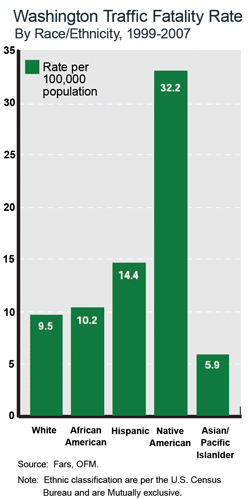
There are 29 Federally Recognized Tribes located within the borders of Washington State. The fatality rate for Native Americans in the State is 3.3 times higher than for non-Native Americans and data from 1999 through 2008 shows Native American fatalities are high across all types of motor vehicle crashes. Native American reservations in Washington often include a mix of Tribal, state, county, and city roads, which creates jurisdictional complexities with law enforcement, collision reporting, road maintenance, and capital safety projects.

Several steps led to increased attention on these Tribal safety issues in the most recent update of Target Zero. Through the annual Centennial Accord (CA), the State of Washington and Tribes have formally committed to working together on a government-to-government basis. Issues addressed by the CA include transportation. During the October 2008 Tribal/State Transportation Conference, Tribal planners and representatives of WSDOT and WTSC discussed traffic safety concerns and partnership opportunities. This led to a larger role for tribes in the update of Target Zero than they had in previous editions.

In May 2009, the state held the Tribal Traffic Safety Summit (sponsored by the FHWA Office of Federal Lands Highway), where WSDOT, WTSC, FHWA, Washington State Patrol (WSP), Northwest Tribal Technical Assistance Program (TTAP), Tribal Transportation Planning Organization (TTPO), Bureau of Indian Affairs (BIA), and National Highway Traffic Safety Administration (NHTSA) joined many tribes to discuss reducing traffic fatalities and serious injuries on reservation roads and among Native Americans in the state. During this summit, tribal, state, Federal staff, and partners focused on the 4 Es of traffic safety (engineering, enforcement, education, and emergency response) and made recommendations on how to elevate Native American priorities within the Target Zero process, as well as recommendations for immediate next steps at the tribal level for stakeholders to take charge of safety issues.

"Bar graph of Washington Traffic Fatality Rate by Race/Ethnicity, 1999-2007: rate per 100,000 population - Native American: 32.2; Hispanic: 14.4; African American: 10.2; White: 9.5; and Asian/Pacific Islander: 5.9"

Leadership involved in the summit carried forward the results from that discussion for consideration during the annual CA on June 23, 2009. Four CA action items resulted, including focusing efforts of WTSC and TTAP to increase tribal involvement in the update and implementation of Target Zero. In addition to carrying forward recommendations from the summit, the new Target Zero update includes strategies from the national Strategic Highway Safety Plan for Indian Lands.

WSDOT circulated draft Target Zero strategies to tribal transportation planners in January 2010 for comment. WSDOT and WTSC then released a preliminary version of the plan in April 2010 for formal tribal consultation, before presenting it to the Governor’s office in May 2010.

Key Accomplishments

  • Held a Tribal Traffic Safety Summit.
  • Reinforced relationship between State of Washington and Tribes provides context for addressing critical safety data challenges.
  • SHSP Target Zero explicitly addresses tribal traffic safety issues.

Results

Actively engaging tribes in discussions and planning has resulted in explicit consideration of Native American traffic safety issues in the update of Washington State’s Target Zero SHSP. The new plan includes an entire section focused specifically on Native American Tribes. In addition, some recommended strategies from the Tribal Traffic Safety Summit are included under the respective emphasis area sections. WSDOT has also offered to collaborate with tribes on the reauthorization of the Federal surface transportation act.

Contact

Lowell Porter
Director
Washington Traffic Safety Commission
360-725-9899
LPorter@wtsc.wa.gov