USA Banner

Official US Government Icon

Official websites use .gov
A .gov website belongs to an official government organization in the United States.

Secure Site Icon

Secure .gov websites use HTTPS
A lock ( ) or https:// means you’ve safely connected to the .gov website. Share sensitive information only on official, secure websites.

U.S. Department of Transportation U.S. Department of Transportation Icon United States Department of Transportation United States Department of Transportation

Noteworthy Practices

Left Nav - HSA Learn Safety

Grant Writing Assistance Focuses on SHSP

Original publication: SHSP Implementation Process Model, Supplement Number 1 – Case Studies; FHWA-SA-10-025; 2010(PDF, 1MB)


Key Accomplishments

  • Developed efficient grant application process.
  • Used current, centralized data rather than local data.
  • Strengthened the partnership between the Highway Safety Office and law enforcement.

The Michigan Office of Highway Safety Planning (OHSP) partners with police on traffic enforcement efforts as part of its annual Highway Safety Plan (HSP). To receive funding, each year every county law enforcement agency and the State Police write grant applications describing the data-driven need for traffic enforcement efforts. Law enforcement agencies typically have few grant writing resources, and in the past it took considerable time to revise grant application drafts by both law enforcement and OHSP staff. To assist law enforcement with this process, the OHSP developed a law enforcement grant shell, or template, to provide a framework for applications.

The OHSP populates the template with current crash data on key SHSP emphasis areas, including safety belts and impaired driving. The grant shell describes general enforcement strategies to support the SHSP, including national mobilization efforts defined by NHTSA and strategies based on State problem identification. The grant application does not dictate methods for enforcement so each agency can customize approaches for its region, but it provides consistency on addressing SHSP goals related to law enforcement.

Results

This approach has allowed law enforcement to minimize time writing grant applications and improved the quality of the applications.

Contact:
Mike Prince
Director
Michigan Office of Highway Safety Planning
517-333-5301
princem@michigan.gov

Utah Flexes HSIP Funds to Enhance Partners' Safety Efforts

Original publication: HSIP Noteworthy Practice Series, Use of the HSIP Flexible Funding Provision; FHWA-SA-11-02; 2011(PDF, 2.8MB)


Overall, the Utah Department of Transportation (UDOT) spends about $20 million per year on roadway safety, one-half of which is funded via a state funding mechanism and one-half via the Highway Safety Improvement Program (HSIP). The State receives about $4 million per year in Federal highway safety grant funding (i.e., Sections 402, 405, 408, 410, etc.). According to crash data, the majority of fatal and serious injury crashes in Utah are behavior related. However, the state funding mechanism is limited to infrastructure investments. Given the level of behavior related crashes, UDOT decided to take full advantage of the HSIP flexibility provision to fund noninfrastructure safety programs. “There is a lot of talk about an integrated approach to safety – the 4Es (enforcement, education, engineering, and emergency response). We are utilizing the flex funds to address the other Es beyond engineering,” said Utah Director of Traffic and Safety Robert Hull.

UDOT has flexed approximately 10 percent of its HSIP funds each year for an annual investment of approximately $900,000 in safety funds for noninfrastructure programs between FY 2006 and FY 2009. This has enabled UDOT to support its overall safety program – Zero Fatalities – and reinforce partnerships with new and existing safety partners through support of their programs. Partners include the Department of Public Safety (DPS); Highway Safety Office (HSO); Utah Department of Health (DOH) Violence and Injury Prevention Program; Utah Safety Council (USC); and Utah Attorney General’s Office. Programs were identified by the partner agencies and then reviewed by UDOT as potential HSIP flex projects, considering their link to the Utah’s Comprehensive Safety Plan (the State’s strategic highway safety plan).

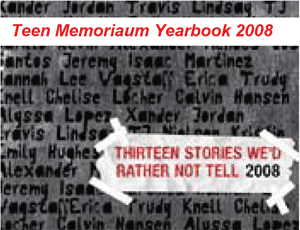
UDOT used flex funds for informational safety and public outreach materials as well as to support the implementation of a multidisciplinary safety summit. One of the projects identified by DPS and DOH was a teen memoriam yearbook, which includes stories from families about teens that have died in crashes. Funding from UDOT pays for the creative development and production while the DOH and DPS work with the families to develop the stories. The book has been used in teen driver education classes for the past two years.

Additional education and outreach programs supported by flex funds include the Operation Lifesaver program to reduce pedestrian crashes at rail crossings and support for USC’s Alive@25 program that promotes safe driving among youth. The 14 Safe Kids chapters across the State receive funding to buy car and booster seats that are given away during Safe Kids Week.

UDOT also contributes flex funds to support a Traffic Safety Resource Prosecutor position. This attorney, who is housed in the Attorney General’s office, works with county and city prosecuting attorneys to help them handle impaired driving-related court cases. The resource prosecutor provides quarterly reports of their activities to ensure objectives of the program are met.

“Applying for flex funds is not difficult given that all the data needed is assembled in other annual reports, including those on the HSIP program, railroad program, Safe Routes to School, and the 5% Report,” said Hull.

"Screenshot of the Teen Memoriam Yearbook 2008 cover"

Key Accomplishments

  • Strengthened relationships in the safety community through funding partner programs.
  • Enabled improved creativity in addressing safety issues.
  • Demonstrated greater levels of success through collaboration.

Results

Since 2000 Utah has experienced a reduction in fatal crashes of 34 percent. In 2009, fatalities were the lowest in 34 years. Overall, flex funding has been used to strengthen the Zero Fatalities Program, the overarching safety effort in Utah. Since Zero Fatalities was initiated in 2005, all of the safety campaigns in the State have been branded with the logo. The last market survey in 2009 showed that Utah residents had a 75 percent awareness rate of the Zero Fatalities campaign and the related safety programs. In addition, the flex funded Traffic Safety Prosecutor has helped cities and counties without experience in impaired driving-related court cases reduce the number of dismissals or reduced charges.

Contact

Robert Hull
Director, Traffic and Safety Division
Utah DOT
801-965-4273
rhull@utah.gov

Teen Driver Study Commission Adopts SHSP Strategies and Advances Legislation

Original publication: SHSP Implementation Process Model, Supplement Number 1 – Case Studies; FHWA-SA-10-025; 2010(PDF, 1MB)


Key Accomplishments

  • Enhanced communication and coordination among the private and public sectors and State legislators.
  • Expedited the implementation of SHSP strategies by partnering with a public-private commission in the young driver emphasis area.
  • Drafted legislation to strengthen the GDL law, require safety belt use in rear seats, and eliminate plea bargaining for GDL licensed drivers.

Despite a strong Graduated Driver Licensing (GDL) law, New Jersey experienced a continued high volume of teen crashes. As a result, leadership identified young driver crashes as an SHSP emphasis area. The SHSP Young Driver Emphasis Area Team developed three primary strategies and 10 action steps to reduce crashes among this population.

Concurrently New Jersey enacted a law establishing a Teen Driver Study Commission. The 15 member Commission is comprised of representatives of both the public and private sector as well as members of the State legislature. The charge of the Commission is to assess teen driving within New Jersey and recommend ways to reduce fatal and injury crashes. The Commission incorporated all of the young driver emphasis area strategies into their 47 recommendations. These are grouped into seven areas: Graduated Driver License, driver education, driver training, enforcement/judicial, insurance industry, schools, and technology. Recommendations requiring legislative action were presented to the Highway Traffic Safety Policy Advisory Council and the legislature.

Results

The leaders of the SHSP effort successfully partnered with the Teen Driver Study Commission and achieved agreement to move the SHSP strategies forward through the Commission. Although agencies receiving public funds are prohibited from lobbying, the private sector members of the Commission have been able to successfully champion bills included in the Commission’s recommended policy initiatives.

Contact:
Pam Fischer
Director, Division of Highway Traffic Safety
New Jersey Department of Law and Public Safety
609-633-9272
Pam.Fischer@lps.state.nj.us

MPO Safety Management Planning

Original publication: HSIP Noteworthy Practice Series, SHSP Stakeholder Involvement; FHWA-SA-11-02; 2011(PDF, 2.6MB)


In 2008, the Cheyenne Metropolitan Planning Organization (MPO) completed its first Transportation Safety Management Plan (TSMP), an MPO level plan akin to statewide SHSPs. The MPO has successfully engaged partners in developing and implementing the TSMP through a combination of activities.

As part of plan development, the MPO convened the first safety summit in the region, involving 60 stakeholders from multiple disciplines. The TSMP defined six emphasis areas requiring focus in the region: impaired driving, occupant protection, distracted driving, older drivers, younger drivers, and intersections. The plan also identified strategies in each area.

Following completion of the TSMP, the MPO developed grant applications seeking funding from the Wyoming Highway Safety Office (HSO) for two safety strategies: a summit for law enforcement personnel to increase enforcement of the secondary occupant protection statute, and development of an intersection safety analysis. These efforts maintained engagement of the law enforcement community in preparation for the summit and the engineering community as they completed the safety study. The MPO submitted a second round of grant applications to the HSO for FY 2010. Activities proposed included a briefing of state legislators on safety issues and a Battle of the Belts competition to increase safety belt use among teens.

In the fall of 2009, the MPO convened meetings of all six emphasis area teams, inviting individuals who had participated in the summit as well as new stakeholders. Each team reviewed the strategies in the TSMP, identified new ideas, and discussed implementation of the two planned efforts for FY 2010. The MPO convened a second set of team meetings in the spring of 2010. The teams developed action plans that are updated on an ongoing basis. HSO staff frequently attend events and are represented on most of the emphasis area teams.

The legislative briefing addressed issues from three of the emphasis areas and engaged a number of stakeholders in its planning. Specifically, the briefing addressed a primary safety belt law, alternative transportation to reduce DUI, and a medical advisory board. Organization of the briefing resulted in engaging a new safety stakeholder, the Wyoming Seatbelt Coalition, which helped the group frame the case for a primary safety belt law at the legislative summit. The MPO has been invited to serve as a member of the coalition, ensuring ongoing communication about the issue. A private sector company in favor of a safety belt law was engaged for the legislative briefing to present the economic benefits of increasing safety belt use through passing a primary safety belt law and demonstrate support for such a change. The American Association of Retired Persons (AARP) served as a speaker given their support of the Medical Advisory Board proposal. A public safety officer from the Casper Police Department, which started a successful alternative transportation program, also served as a speaker and became engaged in sharing information with the Cheyenne Police Department on how to start such a program.
"Cheyenne Area Transportation Safety Initiative logo"

A second effort undertaken in the community in May 2010 was Battle of the Belts, a campaign to increase the rates of safety belt use in high schools. Each school held a contest to increase safety belt use and the winning school received a cash prize. Planning this event engaged members of the younger driver and occupant protection teams. The students on the Mayor’s Youth Council became highly involved in event planning and promotion of the competition at their schools. The project allowed the MPO to develop a strong relationship with the principals of the three high schools in town. The Wyoming Safety Council became involved by delivering Alive@25 assemblies at the schools to kickoff the program. Community businesses donated prizes that were distributed to students during the week of the event to reward those students wearing safety belts. The Mayor and Police Chief presented the award to the winning school demonstrating their support of these efforts and helping to continue to build a culture of safety in Cheyenne.

Plans for FY 2011 involve developing a year-round alternative transportation program. This effort will involve the Cheyenne Regional Medical Center’s Injury Prevention Program and the Cheyenne Police Department, which is in the initial stages of configuring an alternative transportation program in Cheyenne.

Moving forward, the MPO is developing grant applications for safety projects to be conducted in FY 2012 based on ideas developed by the emphasis area teams. Smaller-scale safety efforts are also implemented on an ongoing basis, such as developing a fact sheet for law enforcement on the importance of issuing citations for violations by older drivers instead of warnings to ensure an accurate driving record is captured.

Key Accomplishments

  • Engaged safety stakeholders in six emphasis areas, a law enforcement summit, a legislative briefing, and other projects.
  • Implemented four major safety projects in under two years with help from new stakeholders.

Results

In Cheyenne, safety stakeholder engagement has been built and sustained through MPO leadership – identifying and funding safety projects and working with partners on project implementation. Based on the needs of each project, new safety stakeholders become engaged in the process. Stakeholder interest is sustained when partners have been involved hands-on in implementing a project and see the results. Safety belt use among high school students increased by 10 to 15 percent at each of the schools with the Battle of the Belts Program. An eight-fold increase in citations for nonuse of safety belts followed the safety belt law enforcement summit.

Contact

Sreyoshi Chakraborty
Transportation Planner
Cheyenne MPO
307-638-4384
schakraborty@cheyennecity.org

Level of Service of Safety and Diagnostic Analysis

Original publication: HSIP Noteworthy Practice Series, HSIP Project Identification; FHWA-SA-11-02; 2011(PDF, 2.7MB)


The Colorado Department of Transportation (CDOT) uses two methods for identifying locations with potential for safety improvement: Level of Service of Safety (LOSS) and Diagnostic Analysis. LOSS is based on the concept of Safety Performance Functions (SPF), while Diagnostic Analysis is developed around the idea of statistical pattern recognition.

Design engineers at CDOT pioneered development of the LOSS concept to quantify the magnitude of the safety problem. A crash rate implies a linear relationship between safety and exposure. While crash rates are commonly used to measure safety, they are often misleading since rates change with Annual Average Daily Traffic (AADT). To capture how this rate change takes place, CDOT engineers began calibrating SPFs in the late 1990s based on the work of Dr. Ezra Hauer. By 2001, CDOT had calibrated SPFs for all public roadways in Colorado, which were stratified by the number of lanes, terrain, environment, and functional classification. In 2009, in collaboration with consultants, CDOT developed SPFs for all intersection types.

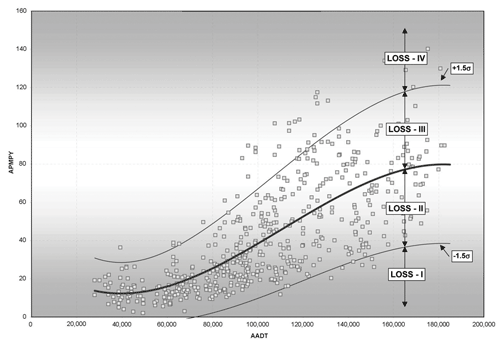
Development of SPFs supports the conceptual formulation of the LOSS concept. It uses qualitative measures to characterize the safety of a roadway segment in reference to its expected performance. If the number of crashes predicted by the SPF represents normal or expected crash frequency at a specific level of AADT, then the degree of deviation from the norm can be stratified to represent specific levels of safety. To describe road safety from the frequency and severity standpoint, two different SPFs were calibrated: one for the total number of crashes and the other for injury and fatal crashes. When the magnitude of the safety problem is assessed, it is described from the frequency and severity standpoint. The figure (Kononov and Allery, 2003) illustrates the LOSS concept using an SPF calibrated for total crashes expected on the 6-lane urban freeways. The delineated boundary line is located 1.5 standard deviations from the mean, reflecting a Negative Binomial error structure. Four LOSS categories were introduced:

  • LOSS-I - Indicates low potential for crash reduction;
  • LOSS-II - Indicates low to moderate potential for crash reduction;
  • LOSS-III - Indicates moderate to high potential for crash reduction; and
  • LOSS-IV - Indicates high potential for crash reduction.

"Chart that illustrates the LOSS concept using an SPF calibrated for total crashes expected on 6-lane urban freeways"

LOSS reflects how the roadway segment is performing in regard to its expected crash frequency and severity at a specific level of AADT. However, it only describes the magnitude of the safety problem; it does not provide any information related to the nature of the problem itself. To investigate the nature of the problem, Colorado uses Direct Diagnostics and Pattern Recognition techniques.

A comprehensive methodology was developed to conduct diagnostic analyses of safety problems. The Direct Diagnostics and Pattern Recognition methods calculate a cumulative binomial probability of the crash types and related characteristics to identify overrepresented elements in the crash data (e.g., dark conditions, overturning vehicles) that may be related to abnormal crash patterns and crash causation. Direct Diagnostics is used for intersection analysis, and Pattern Recognition is used for roadway segments.

CDOT initially used the combination of LOSS and Direct Diagnostics and Pattern Recognition to identify sites with potential for safety improvement only on safety motivated projects. Beginning in 2001, they are applied to all projects at CDOT, including resurfacing, reconstruction, realignment, widening, Environmental Assessments (EA) and Environmental Impact Statements (EIS). CDOT conducts a statewide analysis using Direct Diagnostics and Pattern Recognition and recalibrates SPFs about every five years.

Key Accomplishments

  • Calibrated SPFs for all highways.
  • Developed sophisticated predictive and diagnostic tools to maximize crash reduction in the state within budget constraints.
  • Institutionalized use of these tools throughout the state of Colorado.
  • Achieved unprecedented fatal crash reduction of 36 percent over the seven years of sustained application of these advanced methods on all infrastructure and behavioral projects at CDOT.
  • Provided substantive conceptual and analytical input for the development of the Highway Safety Manual (HSM).

Results

CDOT developed sophisticated predictive and diagnostic tools to maximize potential crash reduction in the state within constraints of available budgets and institutionalized use of these tools throughout the state of Colorado. Over the seven years of application of the advanced methods on all infrastructure and behavioral projects at CDOT, the state has achieved an unprecedented fatal crash reduction of 36 percent, without reduction in travel or increase in safety expenditures. Additionally, these efforts provided substantive analytical and conceptual input for development of the Highway Safety Manual.

Contact

Bryan Allery
Colorado Department of Transportation
303-757-9967
bryan.allery@dot.state.co.us

Jake Kononov
Colorado Department of Transportation
303-757-9973
jake.kononov@dot.state.co.us

Local Safety Coordinators Adopt SHSP Strategies and Actions

Original publication: SHSP Implementation Process Model, Supplement Number 1 – Case Studies; FHWA-SA-10-025; 2010(PDF, 1MB)


Key Accomplishments

  • Used existing CTSP network to focus local safety activities on implementing SHSP action steps.
  • Developed CTSP program evaluation tool to monitor local implementation of behavioral strategies and actions in the SHSP.

The New Jersey Division of Highway Traffic Safety (DHTS) funds Community Traffic Safety Program (CTSP) coordinators in every county in the State. They work with local stakeholders to identify traffic safety problems, develop appropriate countermeasures, and implement or advocate solutions. The coordinators are the county-level focal point for communication and cooperation among local government agencies, the DHTS, and the private sector on traffic safety issues.

The DHTS Director and staff directs CTSP coordinators to link their programs directly with the SHSP in order to extend implementation to the local level. Since FY 2009, behavioral strategies and action steps within the SHSP (impaired driving, occupant protection, pedestrian safety, distracted driving, older drivers, younger drivers, motorcycle safety, and aggressive driving) have been fully adopted as elements in the CTSP business plans.

This has been further strengthened by the development of a CTSP program evaluation that directly links CTSP activities with the SHSP. Performance and outcome measures used to monitor and evaluate CTSP activities relate to the strategies and actions in the SHSP.

Results

All CTSP activities are driven by SHSP emphasis area action plans. CTSP strategic planning documents and program evaluations are linked to SHSP implementation.

Contact:
Pam Fischer
Director
New Jersey Division of Highway Traffic Safety
609-633-9272
Pam.Fischer@lps.state.nj.us

MPO Participation in SHSP

Original publication: SHSP Implementation Process Model, Supplement Number 1 – Case Studies; FHWA-SA-10-025; 2010(PDF, 1MB)


Key Accomplishments

  • Developed MPO safety plans aligned with the SHSP.
  • Deployed regional and local safety countermeasures.
  • Incorporated safety projects into regional TIPs.
  • Enhanced communication between NJDOT and regional, county, and local officials.

Prior to the initiation of the SHSP development process, New Jersey had fully embraced Safety Conscious Planning and established working relationships with its MPOs on transportation safety planning. The SHSP process took metropolitan planning organization (MPO) engagement to the next level. A contact with responsibility for transportation safety was identified in each MPO, and each agency established a transportation safety program.

Once the SHSP development process was underway, MPO safety programs were incorporated into it. Some MPOs have now developed regional safety action plans linked directly to the SHSP emphasis areas. MPOs have also developed alliances with local agencies and organizations to facilitate implementation.

The MPOs view themselves as “Safety Ambassadors” to county and local governments. They provide technical guidance on the collection and analysis of data, develop solutions, and prepare funding proposals. Each MPO collects and analyzes regional safety data. They also develop and implement such safety countermeasure programs as RSAs, safety belt surveys, and deer crash avoidance education programs.

The MPOs have incorporated their safety goals into their long-range plans and use them as a basis for prioritizing projects in their TIPs. Their safety programs and activities are also incorporated into their UPWPs and they have dedicated full-time staff assigned to transportation safety.

MPO efforts are a natural and vital element of the SHSP process. Good communication between the NJDOT and the regional agencies facilitated their participation; no formal Memorandums of Agreement were established, and little or no additional funding was provided.

Results

MPO participation in the SHSP resulted in the development of their own safety programs and action plans aligned with the SHSP. Increased MPO involvement in safety via the SHSP process has resulted in MPOs using safety as a criterion in project prioritization.

Contact:
Patricia Ott
Director, Traffic Engineering and Safety
New Jersey DOT
609-530-2488
Patricia.Ott@dot.state.nj.us

Michigan Uses HSIP Flex Funds for Winter Safe Driving Campaign

Original publication: HSIP Noteworthy Practice Series, Use of the HSIP Flexible Funding Provision; FHWA-SA-11-02; 2011(PDF, 2.8MB)


The Michigan Department of Transportation (MDOT) flexed $45,000 of its Highway Safety Improvement Program (HSIP) funds in FY 2008 to launch a radio public service announcement (PSA) campaign on safe winter driving, which was conducted from December 2007 through March 2008.

The MDOT Communications Department successfully used earned media (news coverage, editorials, etc.) to promote past campaigns, but the number of winter weather-related crashes and the launch of a new slogan and logo – Ice & Snow, Take It Slow – called for increased media exposure. The problem of winter-related crashes also resulted in support for the increased public outreach from the county road commissions around the State.

The MDOT Communications Department oversaw the implementation of the Ice and Snow, Take It Slow campaign, which in the past was supported by state funds. Support for this type of program was in jeopardy based on efforts to direct all state funding toward matching Federal monies on construction projects.

The Ice and Snow, Take It Slow campaign was developed by Clear Roads, a national winter maintenance program with 14 member states. Public information officers from 12 of the state DOTs, including Michigan, contributed time and effort to develop the message based on four top winter safety issues:

  • Speed reduction;
  • Safe travel around snowplows;
  • Safe driving maneuvers; and
  • Trip preparedness.

Speeding is part of Michigan’s Strategic Highway Safety Plan (SHSP) emphasis area on driver behavior and awareness, providing an important link for the Ice and Snow, Take It Slow campaign.

During the winter of 2008, MDOT, which designed the logo for use by 20 states, included the campaign tagline in all news releases, put winter driving safety tips on-line, displayed posters in all Michigan rest areas, and ran a statewide radio campaign. A partnership with the Michigan Association of Broadcasters enabled a wider distribution of the radio PSA, which resulted in securing more than four times the value of the media purchased and greatly extending the campaign’s reach throughout the State.

"Ice & Snow, Take It Slow logo"

Key Accomplishments

  • Used HSIP flex funds to conduct a radio PSA campaign that focused on a high-crash situation, i.e., winter driving.
  • Leveraged a partnership with the Michigan Association of Broadcasters for improved return on investment.
  • Took advantage of existing Clear Roads campaign.

Results

Because of the flex provision, Michigan has been able to sustain the campaign on safe winter driving, resulting in increased public awareness. Michigan fatal crashes in snow have decreased from a five-year rolling average of 77 in 2005 to 63 in 2009. Serious injury crashes involving snow have decreased from a five-year rolling average of 537 in 2005 to 413 in 2009.

Contact

Mark Bott
Traffic Operations Engineer
Michigan Department of Transportation
517-335-2625
bottm@michigan.gov

Truck Safety Commission Supports SHSP Efforts

Original publication: SHSP Implementation Process Model, Supplement Number 1 – Case Studies; FHWA-SA-10-025; 2010(PDF, 1MB)


Key Accomplishments

  • Utilized existing organizational structure to maximize commercial vehicle safety efforts.
  • Conducted commercial driver safety belt survey.
  • Streamlined court processes through prosecutor education on commercial vehicle regulations.

The Michigan legislature established a Truck Safety Commission (TSC) with a dedicated Truck Safety Fund to increase commercial vehicle safety. The Commission is appointed by the Governor and includes members from Michigan Department of Transportation, the State Trucking Association, higher education institutions, the Department of Motor Vehicles, labor groups, private motor carriers, and the Office of Highway Safety Planning. Revenue for the Fund is generated from local trucking company fees, vehicle registrations, and motor carrier fees. Truck safety grants support commercial vehicle education, enforcement, and research. While the Commission predated the SHSP, the existing structure has been tapped to implement strategies for the commercial vehicle safety emphasis area. The TSC’s annual strategic plan serves as the emphasis area action plan for commercial vehicle safety.

TSC activities supporting the SHSP include truck driver continuing education, Share the Road Safely public education, special enforcement operations, education, training for prosecutors and magistrates, and research to enable progress tracking.

Results

Dedicated funding, communication, and collaboration stimulated by the TSC has enabled enhanced commercial vehicle safety efforts and resulted in improved truck safety.

Contact:
Mike Prince
Director
Michigan Office of Highway Safety Planning
517-333-5301
princem@michigan.gov

Local Safety Planning Improved through MPO Outreach

Original publication: SHSP Implementation Process Model, Supplement Number 1 – Case Studies; FHWA-SA-10-025; 2010(PDF, 1MB)


Key Accomplishments

  • Provided technical assistance and funding for local government to identify and implement safety projects.
  • Developed a culture of safety at the local level.
  • Increased the study of local safety issues.

Because a large number of crashes were occurring off the State system, the Ohio Department of Transportation (ODOT) recognized that local jurisdictions needed to be more involved in safety analysis and countermeasure development. Since it is challenging to conduct outreach to so many jurisdictions, ODOT enlisted Ohio metropolitan planning organizations (MPO) to work with local governments to encourage their involvement in safety programs.

ODOT provided training and assistance for MPOs to help them develop more effective, safety-focused relationships with local governments. To support this effort, the State held a series of Safety Conscious Planning forums for MPOs to help them identify safety needs and deficiencies. As a result of the forums, ODOT now assists MPOs with the development of safety work plans. These plans document regional safety goals and objectives, analyze regional crash data, identify regional high-crash locations, propose safety improvements, and identify funding strategies. They also facilitate coordination with local transportation agencies to implement highway system improvements.

MPOs analyze safety data in their regions and develop lists of high-priority locations and/or driver behaviors to target for improvement. Safety studies and projects are then developed from this list and funded with local, State, and Federal funds. In some cases the Ohio DOT provides funding for consultant services to support MPO safety studies.

Results

MPOs are now working with local jurisdictions to analyze data and develop safety work plans. They are focused on addressing regional high-crash locations, understanding regional crash trends, and assisting local governments with funding applications. As a result of these partnerships, a number of major and minor safety projects have been implemented in local jurisdictions.

Contact:
Michelle May
Safety Program Manager
Ohio DOT
614- 644-8309
Michelle.May@dot.state.oh.us