USA Banner

Official US Government Icon

Official websites use .gov
A .gov website belongs to an official government organization in the United States.

Secure Site Icon

Secure .gov websites use HTTPS
A lock ( ) or https:// means you’ve safely connected to the .gov website. Share sensitive information only on official, secure websites.

U.S. Department of Transportation U.S. Department of Transportation Icon United States Department of Transportation United States Department of Transportation

Noteworthy Practices

Left Nav - HSA Learn Safety

Safety Element in Performance Reviews

Original publication: SHSP Implementation Process Model, Supplement Number 1 – Case Studies; FHWA-SA-10-025; 2010(PDF, 1MB)


Key Accomplishments

  • Established regular processes by which DOT district staff work with local agencies to provide technical assistance on safety and support safety project development.
  • Aligned DOT district staff efforts with the SHSP.
  • Institutionalized safety within agency culture.

One way to institutionalize the SHSP and safety is to embed it into agency culture. States are taking this next step by including safety as measurement criteria in key employee performance reviews.

In Michigan, the Michigan Department of Transportation (MDOT) Chief Operating Officer modified performance reviews for district MDOT staff to incorporate safety. Specific measurement criteria in the review include partnering with agencies and organizations to raise safety awareness, train, provide guidance, and improve safety on all State and local roadways. The review also states staff should continue to implement recommendations in the SHSP. Staff is evaluated on progress on certain countermeasures, including successful implementation of the work zone safety policy and rumble strip and cable barrier programs.

In Utah, the Utah Department of Transportation (UDOT) Chief Operating Officer took a more quantitative approach to measuring safety progress with the performance reviews for regional and group directors. Measurement criteria included specific timeframes for identifying and submitting safety spot improvement projects, beginning construction on non-advertised safety spot improvement projects, and completing a regional review of possible locations that may meet signal warrants after receipt of the requested study. Regional and group directors were all given a numeric goal by which to reduce traffic-related and pedestrian fatalities, which equated to a two percent reduction from the previous year. Regional directors are also required to conduct quarterly staff meetings to review fatalities and identify action items to address each goal. Included in a monthly meeting between the Regional and Group leaders and the Department Deputy Director is a review of current traffic fatalities. The Governor-appointed Transportation Commission is also updated by DOT staff on the current status of traffic fatalities.

Results

Incorporation of safety into the performance review process raised the profile of safety and ensured it is integrated into the work processes of DOT district staff.

Contact:
Mark Bott
Traffic Operations Manager
Michigan DOT
517-335-2625
bottm@michigan.gov
Speeding and Aggressive Driving and Distracted Driving Task Forces

Original publication: HSIP Noteworthy Practice Series, Revisiting SHSP Emphasis Areas; FHWA-SA-11-02; 2011(PDF, 1.9MB)


Louisiana published their original Strategic Highway Safety Plan (SHSP) in September 2006. Using the American Association of State Highway Transportation Officials (AASHTO) SHSP as a point of departure, the State examined data and identified 11 high-priority emphasis areas with the most promise for driving down the human and economic costs of crashes. In 2009 Louisiana began the process of updating the SHSP with one of the primary stated objectives to “narrow the focus of the SHSP to the areas of greatest need and potential for success as identified through a detailed data analysis process.”

The update process included examination of the data and outreach to safety stakeholders. While attempting to narrow the focus, a careful look at the data revealed some difficulties in assessing the nature and true extent of two of the original emphasis areas – speeding and aggressive driving, and distracted driving. Aggressive driving is a difficult concept to define and involves several typical violations associated with driver behavior. The most often cited violation in aggressive driving crashes is “careless operation.” The 2005 crash report form introduced a new variable addressing distracted driving. However, in many cases, looking closer at the data revealed the factors contributing to distraction were often recorded as “unknown.”

The SHSP Implementation Team recognized aggressive driving and distracted driving represent significant safety problems. However, the Team believed a pragmatic and beneficial approach would be to establish task forces to examine these issues in greater depth before they could conduct the necessary emphasis area level analysis. This resulted in the creation of two Task Forces with the following roles:

  • Determine infraction definitions, i.e., develop a definition that can be used by law enforcement, the judiciary, etc.;
  • Review the literature and research to identify effective countermeasures;
  • Review current practice and laws to determine and propose changes;
  • Participate in quarterly SHSP implementation team meetings; and
  • Report findings to the Executive Committee and Implementation Team.

By establishing the task forces on aggressive driving and distracted driving, Louisiana maintained a data-driven approach to defining SHSP emphasis areas with the greatest potential to reduce fatalities and serious injuries while acknowledging the potential significance of such topics.

"Destination Zero Deaths logo"

Key Accomplishments

  • Maintained a data-driven approach to identifying SHSP emphasis areas.
  • Provided a framework for addressing significant “developing” emphasis areas.

Results

To date, approximately 40 stakeholders representing the 4 Es of safety (engineering, enforcement, education, and EMS) have signed up for either the Distracted Task Force or the Aggressive Driving Task Force. The Task Forces are setting out to determine: 1) appropriate methods for analyzing the data to develop a clear picture of the problem; and 2) effective countermeasures. Once those tasks are accomplished, the intent is to transition the “developing” emphasis areas into full SHSP emphasis areas.

Contact

Dan Magri
Highway Safety Administrator
Louisiana Department of Transportation
and Development
225-379-1871
Dan.Magri@la.gov

Alabama Flexes HSIP Funds for Increased Enforcement

Original publication: HSIP Noteworthy Practice Series, Use of the HSIP Flexible Funding Provision; FHWA-SA-11-02; 2011(PDF, 2.8MB)


Thirty percent of speeding crashes and 60 percent of roadway departure crashes occur on the 11,000 miles of Alabama’s state highway system. According to Wes Elrod, Transportation Planning and Modal Programs Assistant Bureau Chief, a review of the data and current countermeasures indicated a need for increased enforcement.

Until the flex funding option became available in FY 2006, the Alabama Department of Transportation (ALDOT) did not have a mechanism to provide direct financial assistance to the Department of Public Safety (DPS) for increased enforcement on the state system. The Highway Safety Office (HSO) distributes a significant proportion of its National Highway Traffic Safety Administration (NHTSA) funds to local governments and only a limited amount to DPS. Recognizing limited resources for traffic enforcement, ALDOT used HSIP flex funds to increase enforcement strategies identified in the strategic highway safety plan (SHSP) addressing behavior to complement infrastructure improvements and more effectively reduce roadway departure crashes. ALDOT flexed between five and eight percent of its HSIP funds annually from FY 2007 to FY 2010, resulting in $1.5 to $2.8 million spent on noninfrastructure safety projects each of the past four years.

The majority of the flex funds paid for overtime for state police troopers to conduct speed enforcement activities, which is a strategy in the state SHSP Risky Driving Emphasis Area. ALDOT worked with the state police to determine how much overtime enforcement they could handle given personnel levels and agreed on an appropriate amount of HSIP funds to flex each year.

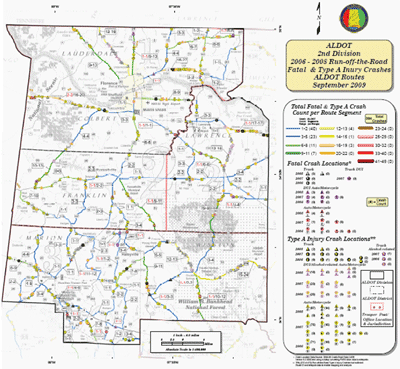
ALDOT identified fatal and serious injury crash locations and provided crash maps to the state police. Using the Critical Analysis Reporting Environment (CARE) crash records system ALDOT identified the time of day and the type of crashes. Troopers then focused their overtime efforts on those times and locations. ALDOT divided HSIP funds among the 12 state police trooper posts proportionally based on the number of high-crash corridors in each area.

ALDOT closely monitored enforcement results and made adjustments as necessary. In quarterly reports, the state police provided the hours worked by each trooper and citations issued during overtime enforcement periods. ALDOT continuously evaluated results to ensure safety goals were met and whether the effort was a successful countermeasure for reducing both speeding and lane departure crashes.

"ALDOT 2004-2008 color-coded Run-off-the-Road, Fatal & Type A Injury Crashes map and legend"

Key Accomplishments

  • Strengthened the partnership with Department of Public Safety, which is a member of the SHSP Executive Committee.
  • Implemented an enhanced data-driven program of enforcement on the state highway system.
  • Took advantage of joint crash data system to provide crash maps and time of day information to DPS.
  • Increased the efficiency of state law enforcement by funding improved radar and GPS devices.

Results

Flexing HSIP funds for use by DPS for enforcement has resulted in a strong partnership between the state police and ALDOT staff, while addressing noninfrastructure emphasis areas from the SHSP. This effort has resulted in increased deployment of enforcement resources on the state highway system based on crash data. From 2007 to 2009 the number of fatal crashes involving speeding decreased 31 percent, from 369 in 2007 to 255 in 2009.

Contact

Waymon Benifield
Safety Management Section Administrator
Alabama DOT
Phone 334-353-6404
benifieldw@dot.state.al.us

Wes Elrod
Assistant Bureau Chief, Modal Programs
Alabama DOT
Phone: 334-353-6407
elrodw@dot.state.al.us

Florida Uses Web Tool to Develop State-Specific Crash Reduction Factors

Original publication: HSIP Noteworthy Practice Series, HSIP Project Evaluation; FHWA-SA-11-02; 2011(PDF, 2.3MB)


Crash reduction factors (CRF) provide agencies with an estimate of the expected crash reduction and/or benefits associated with various countermeasures. However, since local conditions (e.g., roadway, driver, traffic, weather, crash investigation techniques) may vary from agency to agency, state specific CRFs provide a more accurate indication of the effectiveness of various countermeasures. Prior to the development of the Crash Reduction Analysis System Hub (CRASH), the Florida Department of Transportation (FDOT) did not have a central database that combined crash data and safety project data to determine CRFs, or a mechanism in place to provide FHWA with a report on the effectiveness of safety projects in reducing crashes. The individual districts maintained the historical data for their safety improvement projects, which were in various formats and were not easily accessible for developing CRFs. In an effort to systematically maintain statewide safety improvement project data and facilitate a continual process of developing and updating state specific CRFs, the FDOT funded a research project with the Lehman Center for Transportation Research to develop the CRASH application.

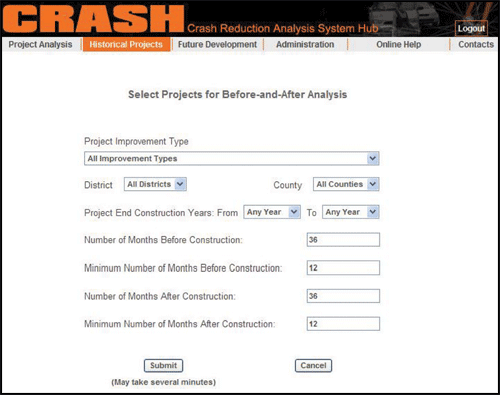
The CRASH application is a web database of safety improvement projects on the FDOT intranet. The District Safety Engineers (DSE) input all Highway Safety Improvement Program (HSIP) funded projects into CRASH, which stores individual safety improvement projects and crash data. The application uses before and after crash counts to evaluate the CRFs for the countermeasures implemented in the safety improvement projects entered in the system. The State Safety Engineer (system administrator) updates the CRFs annually; although they can be updated at any time. The CRFs are typically calculated based on five years of before and after data, but the system administrator may specify a time period for the calculation.

The CRASH application enables the DSEs to easily evaluate different countermeasures and conduct a benefit-cost analysis by inputting project limits and selecting crash data years. CRASH currently includes 135 different improvements types. When the user selects a proposed countermeasure, the application provides a range of CRFs for crashes in various categories based on historical crash reductions or increases associated with past projects. The user can select the standard CRF or input a user defined value in cases where no sufficient studies in Florida exist to develop a state specific CRF.

The CRASH system enables easy performance tracking of safety efforts. It provides various functions for data retrieval and exportation for other analysis and reporting purposes, including the annual HSIP report.

"Screen shot of the CRASH web application, with the Historical Projects menu tab selected, which allows the user to Search Projects for Before-and-After Analysis using eight search parameters"

Key Accomplishments

  • Developed an online database of safety improvement projects and state-specific CRFs.
  • Automated processes for benefit-cost analysis and safety project evaluations.

Results

The CRASH application has enabled Florida to develop state-specific CRFs for several countermeasures based on the evaluation results of implemented HSIP projects. The system has also reduced the level of effort required to conduct benefit-cost analyses and project evaluations by automating the processes.

Contact

Joseph Santos
Transportation Safety Engineer
Florida Department of Transportation
850-245-1502
joseph.santos@dot.state.fl.us

Emphasis Area Team Facilitators

Original publication: SHSP Implementation Process Model, Supplement Number 1 – Case Studies; FHWA-SA-10-025; 2010(PDF, 1MB)


Key Accomplishments

  • Developed action plans for all emphasis areas in the SHSP.
  • Garnered maximum stakeholder involvement through tailored team management strategies.
  • Achieved cross-education of team members with a range of expertise.

Michigan formed 12 emphasis area teams facilitated by Office of Highway Safety Planning staff to develop and implement action plans for the SHSP emphasis areas. Given the nature of the topics and the range of stakeholders involved, the most effective management strategy is to tailor each team’s operation to its dynamics. Team management varies in the use of subcommittees, meeting frequency, and approaches for writing action plans.

Depending on the topic and group dynamics, team facilitators assist each team’s stakeholders in developing a management strategy. For example, the Young Driver Action Team conducts many of its meetings, including all members so subgroups can learn from each other. The committee chair of the Senior Mobility Team meets with individual stakeholders on specific topics and handles engineering and behavioral issues separately. Teams try to calibrate their meeting schedules to the group’s level of activity to ensure maximum productivity during meetings and keep members actively involved. The Motorcycle Team meets as a committee of the whole two to three times per year, avoiding meetings in summer because it is the busiest season for the motorcycle community.

Teams use both a centralized and decentralized approach for developing action plans. Some teams employed subgroups to write sections and subsequently merged them into a complete plan. Some agencies drafted a plan and sought comment from the team members. One team hired a consultant to write the draft plan followed by input from the team members. A strong leader collects all input and finalizes the language for each action plan for consistency and clarity.

Results

All emphasis area action teams successfully developed plans for SHSP implementation, and all teams are actively implementing strategies identified in the plans.

Contact:
Mike Prince
Director
Michigan Office of Highway Safety Planning
517-333-5301
princem@michigan.gov

LTAP Support to Local Agencies

Original publication: SHSP Implementation Process Model, Supplement Number 1 – Case Studies; FHWA-SA-10-025; 2010(PDF, 1MB)


Key Accomplishments

  • LTAP staff routinely promote SHSP concepts when working with local transportation agencies, broadening the reach of the SHSP.
  • Local agencies receive assistance with data collection and input efforts.
  • SHSP working groups receive local insight and hear about local concerns via LTAP personnel.

Communicating the SHSP to local agencies is a required first step toward implementation of safety strategies at the local level. Local Technical Assistance Programs (LTAP) serve as conduits, transferring highway technology from FHWA, the State DOT, and universities to local transportation agencies. Utah is using the LTAP to disseminate information about the SHSP to local jurisdictions.

LTAPs provide workshops, publications, videos, and other training materials to local agencies to improve the effectiveness of their transportation programs. They also support Road Safety Audits (RSA) and provide direct technical assistance for dealing with transportation challenges.

In Utah, LTAP personnel regularly promote the State’s SHSP in their work with local agencies. Actions by local agencies can directly impact SHSP implementation efforts. LTAP personnel are helping local agencies collect and manage crash data, thereby improving its accuracy, timeliness, and completeness. LTAPs also provide software with potential safety benefits to local agencies (e.g., sign inventory software).

LTAP staff are able to give insight into local issues and concerns to UDOT through their involvement with local agencies. UDOT personnel also gain additional knowledge of local issues through their participation in RSAs. This local information is provided to the SHSP emphasis area working groups to fine tune or modify their action plans.

Results

By tapping into relationships already in place through the LTAP program, Utah is able to collect information, ideas, and other inputs from local agencies and share it with emphasis area teams, ensuring that local input is considered as the SHSP is implemented.

Contact:
Robert Hull
Director, Traffic and Safety Division
Utah DOT
801-965-4273
rhull@utah.gov

Emergency Medical Services Partner

Original publication: SHSP Implementation Process Model, Supplement Number 1 – Case Studies; FHWA-SA-10-025; 2010(PDF, 1MB)


Key Accomplishments

  • Involved EMS agency as a prominent stakeholder and leader in the SHSP implementation effort.
  • Established a separate EMS emphasis area to increase EMS role in safety implementation.
  • Provides EMS knowledge and expertise to all of the SHSP implementation teams.

Originally, Maryland’s SHSP development process envisioned EMS as part of all emphasis areas. However, given the importance of EMS in improving safety, the State EMS Director felt a more focused effort was needed. The Executive Director of the Maryland Institute for Emergency Medical Service Systems (MIEMSS) discussed the issue with the SHSP Executive Committee, and they decided to add EMS as a separate emphasis area. The EMS emphasis area team, which includes key EMS and law enforcement representatives, developed an action plan funded primarily by the State EMS agency.

The MIEMSS Public Information Director was assigned to work with the Executive Director and other members of the emphasis area team on the implementation plan and serve as cochair of the SHSP Public Information Committee. This committee meets periodically to review various public information and education activities such as the “Choose Safety for Life” campaign launched in the summer of 2008.

MIEMSS promotes safe driving through a number of other activities, such as the “Drunk Driving – It’s Been Done to Death” media campaign launched in October 2007. The agency also advises the Distracted Driving emphasis area team. For example, with their input the team eliminated an action step to implement the use of screens for blocking traffic incidents from motorist view due to the view shared by both EMS and law enforcement that the action was unworkable.

Results

Creation of an EMS emphasis area raised visibility of this important safety component among SHSP stakeholders. The EMS team made significant contributions to public information efforts. EMS stakeholders actively contribute to other emphasis areas, further reinforcing the 4E approach to safety.

Contact:
Jim Brown
Director of Public Information and Media Services
Maryland Institute for Emergency Medical Services Systems
410- 706-3994
jbrown@miemss.org

New Jersey Provides Data Decision Support Tool to SHSP Partners

Original publication: HSIP Noteworthy Practice Series, Safety Data Collection, Analysis, and Sharing; FHWA-SA-11-02; 2011(PDF, 1.6MB)


The New Jersey Department of Transportation (NJDOT) recognized a need to provide transportation safety data in a more user-friendly format. Providing easier access to data and enhanced analytic capabilities would encourage participation by safety partners in the State’s various safety programs, including its SHSP efforts.

The State contracted with the Rutgers University Transportation Safety Resource Center (TSRC) to develop a roadway safety decision support tool. This software program enables users to quickly filter, analyze, and map crash records. The tool also allows merging of specialized data sources with crash records, enabling in-depth analysis.

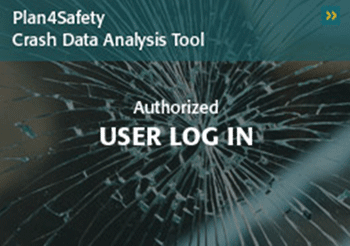
The TSRC developed the software as a web-based application to enable public agency personnel to quickly analyze safety data. By hosting the tool on a platform of servers, large amounts of data can be accommodated with little effect on execution speed. The application processes queries submitted on-line, produces reports mapping crash location and severity, and identifies contributing factors. Users can access the software from any Internet-enabled computer without requiring a high level of computing power. The program is secured through the use of login IDs and passwords to protect content and allows users to save filters and preferences. The program enables network screening, economic analysis, and diagnosis. The network screening layer integrates methodologies currently used by safety engineers to locate high-crash intersections or segments. Crash rates can be calculated for any filter/query. The software also includes a model to predict crash frequencies and severity for selected roadways. Future elements will incorporate the safety performance function calculations from the new Highway Safety Manual into the program for all classifications of roadways to determine which locations have the greatest potential for safety improvement.

"Screenshot from New Jersey DOT's on-line Plan4Safety crash data analysis tool"

The Center also provides engineering, planning, training, and outreach services to local governments and assists with crash data analysis to support SHSP implementation. NJDOT funds work of the TSRC through the HSIP.

Key Accomplishments

  • Developed new system for on-line access to transportation safety data enabling safety partners to make data-driven safety decisions.
  • Enhanced capabilities to analyze data and tailor reports to support safety initiatives.
  • Distributed safety data broadly to encourage greater SHSP participation.

Results

The web-based software tool supporting collection, analysis, and distribution of transportation safety data has been instrumental in the development and implementation of the SHSP. The approximately 500 agencies using the analysis software enjoy easy access to transportation safety data and can perform analyses to support their local safety initiatives as well as those at the state level. Broad dissemination of safety data and the availability of this tool has encouraged participation in the SHSP by safety partners at all levels.

Contact

Patrick Szary
Associate Director
Center for Advanced Infrastructure and Transportation (CAIT)
732-445-0579, Ext. 106
szary@rci.rutgers.edu

Motor Vehicle Administration Partner

Original publication: SHSP Implementation Process Model, Supplement Number 1 – Case Studies; FHWA-SA-10-025; 2010(PDF, 1MB)


Key Accomplishments

  • Assumed a strong leadership role in SHSP implementation.
  • Secured MVA employee involvement and buy-in on SHSP implementation.
  • Created Driver Safety Division within MVA.

The Maryland Motor Vehicle Administration (MVA) is a member of the SHSP Executive Committee and signed a MOU stating their support for the SHSP. Once the SHSP was developed, it was important to the Management Committee and the SHSP Champion that Executive Committee members live up to the commitments in the MOU and take responsibility for implementation. This was a theme mentioned at each Executive Committee meeting and at both Traffic Safety Summits. At an Executive Committee meeting in December 2006, members were asked to assume responsibility to monitor implementation of the various emphasis areas. Given their important role in safety, the MVA agreed to lead implementation for the following emphasis areas:

  • Distracted Driving;
  • Older Drivers;
  • Younger Drivers;
  • Motorcycle Safety; and
  • Truck and Bus Safety.

Each of these areas relates specifically to work conducted by the MVA. Because these efforts involve several offices and divisions within the MVA, the Administrator felt it was important to have a single individual coordinate all activities, including the preparation of quarterly progress reports. In January 2007, the Administrator designated an individual within the MVA to monitor the work of the emphasis area teams because “we are a safety agency, and it is important we do our part to improve safety through the SHSP,” he said. No additional funding was necessary for this position as the SHSP coordinator responsibilities were assigned to an existing MVA staff member.

In addition to the SHSP coordinator, two MVA staff members volunteered and continue to be actively involved as emphasis area team leaders, and the MVA has taken a lead role on numerous individual strategies and action steps.

Results

Propelled by the Administrator’s leadership, the Maryland MVA has taken an active role in ensuring SHSP implementation: a single designated coordinator overseeing five emphasis areas, two emphasis area team leaders, and a number of leaders for strategy and action steps. Reflecting this commitment to the SHSP, and safety as a whole, the MVA created a Driver Safety Division.

Contact:
Nanette Schieke
Chief, Driver Safety Division
Maryland Motor Vehicle Administration
410-787-7977
nschieke@marylandmva.com

SHSP Project Seed Money

Original publication: SHSP Implementation Process Model, Supplement Number 1 – Case Studies; FHWA-SA-10-025; 2010(PDF, 1MB)


Key Accomplishments

  • Dedicated significant funding to SHSP implementation.
  • Developed criteria for project identification and a prioritization process based on expected fatality reduction.
  • Reenergized emphasis area teams.

After Georgia’s initial development of the SHSP, stakeholder participation in the process slowed and dedication to the implementation process needed a boost. Stakeholders needed clear incentives to participate in the process and tangible implementation tools. Therefore, Georgia decided to allocate $10 million seed money from the §406 Safety Belt Performance Award to fund implementation of SHSP programs and projects.

The SHSP Leadership Team is responsible for deciding which projects are funded through the seed money. Project ideas first come from the emphasis area task teams, and the Leadership Team prioritizes projects based on benefit/cost, expected fatality reduction, and the extent to which projects address SHSP emphasis areas. A project prioritization matrix is used to rank proposed projects based on the extent to which each one will reduce fatalities. The matrix uses the estimated percent contribution of each emphasis area addressed by the project to the total number of fatalities Statewide to calculate a project score. The score is then used to rank proposed SHSP projects. The team intends to fund strategies and/or projects that address as many of the 4Es (e.g.; engineering, enforcement, education, and emergency response) as possible.

The implementation funds serve as an incentive for SHSP stakeholders to collaborate on multidisciplinary projects and work beyond agency boundaries. Because projects addressing the 4Es are difficult to implement within a single agency, the Leadership Team places an emphasis on providing resources for these projects.

Results

The SHSP process has gained momentum and received renewed interest as a result of this new funding strategy. Dedicated funding provides an incentive for partners representing the 4Es to collaborate on projects and for the 4Es to be incorporated into overall strategies.

Contact:
Randy Clayton
SHSP Operations Manager
Georgia Governor’s Office of Highway Safety
404-651-8503
rclayton@gohs.ga.gov